1467 stories
·
0 followers

Likely illegally, Claude gained access to 3 networks. Will Anthropic be held to account?

1 Share

Anthropic said its Claude-based security models gained unauthorized access to the sensitive production environments of three outside organizations during internal testing designed to measure the models’ offensive cyber capabilities.

The events, which Anthropic revealed Thursday, are the second revelation in 10 days that AI models from the world’s wealthiest providers have trespassed into protected networks, an offense that, in more traditional hacking scenarios, could land the human behind the keyboard in prison for years. Earlier this month, OpenAI said its security models exploited a zero-day vulnerability for use in breaking into the network of Hugging Face, a platform for open source machine-learning models and AI datasets. The OpenAI models went on to steal access credentials and other confidential Hugging Face information. The OpenAI models also exploited publicly exposed credentials to compromise accounts of four other third-party services.

Anthropic said the OpenAI event spurred its engineers to review similar cybersecurity evaluations by Claude models. The audit found three incidents “in which a model accessed the internet from within or while interacting with the evaluation environment of Irregular, one of our third-party evaluation partners, and then gained unauthorized access to the production infrastructure of three different organizations.”

When Models fail to discern reality from fiction

Anthropic said the prompts engineers delivered during “capture the flag” challenges—a common means for assessing the offensive and defensive capabilities of various hacking techniques—made clear that the testing environment was only a simulation and that the models had no access to the open Internet. In fact, the testing partner Irregular mistakenly made such access available. In response the models treated the Internet paths as part of the exercises.

The intrusions happened through three Claude models: Opus 4.7, Mythos 5, and an internal research prototype. Opus 4.7, the oldest of the three, was the one that overstepped its boundaries the most. Anthropic explained:

Operating under the false belief that all accessible entities were intended to be in-scope for the exercise, Claude compromised the impacted organizations’ infrastructure using basic techniques, such as exploiting weak passwords and unauthenticated endpoints. It did not find or exploit any complex vulnerabilities, and in each case, Claude continued working to complete only the specific capture-the-flag task its evaluation had assigned. However, in some cases, our older model continued its attack even after getting evidence it was running on the open internet; our latest model stopped once it recognized it was on the internet. In none of these situations did Claude exfiltrate itself or deliberately attempt to escape its test environment.

While the Opus model continued its attack even after correctly predicting that it had breached the third-party organization's production system, Anthropic said, Mythos 5 made a similar inference but “reasoned its way back to the conclusion that it was still in a simulation.” That meant that Mythos, too, didn’t abort the exercise once it had clearly stepped over the line. After also exceeding the bounds of level behavior, the internal test model eventually found evidence that it, too, had impinged and stopped the exercise.

In the first of the three intrusions, Opus 4.7 was initially unable to breach the simulated target it was prompted to attack. Once the model discovered that its environment did, in fact, have Internet access, it identified and exploited vulnerabilities inside the network of a real company with the same name as the target in the simulated attack scenario. In four runs, the model extracted application and infrastructure credentials and several hundred rows of production data. Anthropic said the incursion was the most serious of the three.

“This incident involved Claude Opus 4.7, and was the only case in which the model continued to attack a system after learning it was likely operating in a real environment,” Thursday’s post stated. “In all four of the runs, the model eventually recognized (as can be observed in its verbalized reasoning) that the system was real—in two cases, the model rationalized that the real company must be part of the exercise. However, none stopped the attack on that basis.”

In the second instance, Mythos 5 detected a document inside the fictional environment that the model reasoned was another made-up company’s setup instructions for new developers. The instructions directed employees to install a non-existent Python package from PyPI. Still following prompts to breach the first fictional company, the model built and published a malicious package with the same name. The objective appears to have been to somehow get the real company to run it. The Anthropic post-mortem went on to say:

Claude went to extensive lengths to carry out this attack—lengths that would likely have indicated to a human participant that this was no longer just an evaluation, and that they were in fact uploading a real PyPI package. For instance, in one case, in order to create a PyPI account, Claude needed an email address. And in order to create an email address, it needed a phone number. To get a phone number, after failing to find a free phone number service, it tried—and failed—to obtain funds to pay for a phone number through several different means. It finally backtracked, found a free, non-blocked email provider, used this to register a PyPI account, and then used this account to upload malware to PyPI.

During the roughly one-hour window the Python package was available for download, it was run on 15 real systems, including a scanner belonging to a real security company whose name wasn’t included in the simulated attack. When the malicious code executed, it sent the security company’s credentials to a collection point the Mythos model had implemented. Once in possession of the credentials, Mythos used them to gain further unauthorized access to the company’s infrastructure.

Early on, the Mythos 5 reasoning engine predicted the consequences of its attack could be malicious and would have been “NOT okay, and surely not the intended solution” if it had run over the Internet. The model failed to detect it was no longer running inside the protected environment, and hence didn’t abort the incursion.

In the world of AI, where's the accountability?

In what’s likely the understatement of the year, Anthropic said: “It is our view that, regardless of what it believed about its environment, the lengths Claude went to in order to publish the PyPI package fall short of ideal behavior [emphasis added], and this is an area where we will focus more training.”

In the third breach, the research prototype had trouble achieving the instructions it was prompted to follow. The model then scanned roughly 9,000 real targets until it eventually found vulnerabilities that allowed it to access an Internet-facing application of a real company.

“For most of the run, Claude treated the (real) hosts it reached as just parts of the exercise; it assumed them to be simulated and believed its actions were therefore harmless,” Anthropic said. “However, later in the run, Claude realized that the compromised host sat in a cloud account with no connection to the capture-the-flag challenge. On its own, it concluded that the target was in fact real, and ceased its attack.”

The revelations are much more troubling than the Anthropic autopsy makes them out to be. Models from two of the most powerful AI platforms have committed what would likely amount to multiple felonies had the incursions not involved AI. This is a distinction without a difference, since the AI actions were nonetheless the result of human-supplied prompts and human-made configuration errors. So far, however, there are no indications that law enforcement authorities have any plans to take action. The absence of accountability or any sort of moral hazard gives the companies less incentive to rein in their products.

Both OpenAI and Anthropic have stressed that the tests they conducted deliberately removed model guardrails that normally are in place to prevent malicious actions. Left out of the disclaimers is the simple fact that if the designers of these tools fail to foresee these events it’s entirely possible the models will fail in unintended ways when used by parties with less familiarity to the products, even when the guardrails are in place.

There’s no reason to think events like these will be isolated. In its current form, offensive cyber AI represents an unprecedented threat, and at the moment, there’s little recourse other than to trust these companies to police themselves.
Read full article

Comments


Read the whole story
Share this story
Delete

Does Eating Less Protein Produce Healthier Aging and Metabolism?

1 Share
"A major scientific review is challenging the idea that more protein is always better," reports ABC News: The review, led by pathologist and biomedical researcher Dudley Lamming and published in the journal Cell Press Blue, examined more than 350 studies involving humans, mice, insects, yeast, and other organisms. The review found that eating less protein, or less of certain amino acids that make up protein, may turn on body processes linked to healthier aging, as well as metabolism, the process by which the body turns food and drinks into energy... For adults who already get enough, eating more protein may offer little benefit, while some research suggests that eating less protein could support healthier aging... Lamming reviewed the effect of reducing protein in many body processes. One of the processes involves a hormone called FGF21. "There's an increase in a hormone called FGF21 that promotes energy expenditure [when protein intake is reduced]," Lamming said. "It essentially increases thermogenesis in your adipose tissue, so you don't just store fat, but actually burn it as fuel." This may help explain why some studies connect lower-protein diets with less body fat, better blood sugar control and a healthier metabolism. Eating less protein may also affect signals that tell cells when to grow, repair damage or recycle old cell parts. These jobs may play a role in aging. However, protein restriction is not the same as protein deficiency. The goal is not to deprive the body of an essential nutrient. Instead, the research raises the possibility that avoiding unnecessary excess could benefit some people who already consume enough... Before reaching for another high-protein product, a better question may be: How much protein does my body actually need?

Read more of this story at Slashdot.

Read the whole story
Share this story
Delete

The report oil companies are worried about: Climate attribution science

1 Share

Climate change is being driven largely by the greenhouse gases we've pumped into the atmosphere, which trap more of the Sun's energy there. That added energy increases the odds of extreme events: longer, more intense heat waves and droughts, interspersed with excessive precipitation. But these sorts of events have happened in the past—how can we tell if any given weather disaster has been made more likely by the climate?

It's a question with implications for everything from building codes to disaster preparedness. And there's some good news: According to a report released by the US National Academies of Science on Thursday, the field of climate attribution is growing increasingly mature and can answer some questions for us with far greater confidence than it could just a decade ago. The report also notes that there are still important limits and suggests steps to address them.

Overall, this makes it clear that climate attribution is normal, mainstream science. And the fossil fuel industry views that as a problem, as it could make it easier to hold companies liable for damages. This has triggered a backlash that has Republicans in Congress and state governments threatening the National Academies' funding.

A decade of progress

Heat waves, excessive precipitation, and other extreme weather events have been happening throughout Earth's history. The relatively stable climate humanity has enjoyed since the end of the last glacial period has meant that historic extremes typically fall within a relatively narrow range. But we've been exiting the stable climate humanity has been familiar with, so we should expect events that fall outside the normal range of variability we're accustomed to. Can we recognize them when they happen?

That question is linked to a query that has accompanied many weather disasters—the public wants to know if it was the outcome of the global warming we've been warned about.

Attribution science has been developed to try to answer these questions. At its simplest, it identifies the major atmospheric features associated with a weather event and then asks how often they occur in climate models under two scenarios: one with our present conditions and one without humanity's greenhouse gas emissions. The difference in frequency within these two scenarios provides a measure of the influence of climate change.

This approach has been through peer review and has since been used to examine a wide variety of weather events, many of which show the fingerprint (or, in some cases, the fist print) of climate change. There have also been some instances where the methods don't provide a clear picture.

Understanding the role of climate change in these events can be useful for more than satisfying public curiosity. A lot of our infrastructure and regulations are based on the patterns of events we've observed in the past. If those patterns no longer apply, then a lot of things need updating. Obvious examples include the drainage needed to handle typical precipitation or the temperatures a road material will need to tolerate without melting.

Given the importance of these policy implications, it's no surprise that the National Academies of Science (NAS) have been called on to weigh in on the state of the field; one of its roles has traditionally been to evaluate complex areas of science and provide a summary that policymakers can use. In fact, the NAS was asked to weigh in back in 2016, when the field was developing rapidly. A decade later, it was asked to take a look at where those developments have led.

Degrees of difficulty

The report provides a great overview of how attribution analysis works, where it succeeds, and what challenges keep it from being effective in some circumstances. But one of the first things it makes clear is that the field has gotten better since the NAS last checked in. "Over the past decade, advances in physical understanding—through accumulating observational and modeling evidence supporting long-standing theoretical expectations—together with improved and more sophisticated numerical models, expanded observational datasets, and advanced statistical and machine-learning techniques, have strengthened the foundation for extreme event attribution," the report's authors write. "This progress has led to more robust assessments and an increased ability to examine a broader range of extreme event types."

While there have been (and continue to be) new approaches developed for answering questions, the report says that most of the work is being done within one of two frameworks. The first is called "probabilistic," which focuses on how climate change has altered the odds of a similar event occurring. The second is termed "storyline," and is more focused on the specifics of the weather event (to give one example, the frequency of large hailstones) as well as the atmospheric conditions that make them possible. Storylining is especially useful for events like tropical cyclones, where the frequency is rare but some of the atmospheric conditions that contribute to their trajectory or rainfall might show up far more often.

Both of these have benefitted from the same advances in climate science: better models, a greater theoretical understanding of how atmospheric conditions influence weather events, datasets that cover more years and new parts of the globe, and more.

That said, there are some clear limits to what we can do. The biggest of these is simply a lack of historical data. Weather monitoring in the pre-satellite era was not very consistent, and there are areas of the Earth, especially in the Global South, where we simply don't have good enough records to assess the long-term probabilities of some events. Obviously, things get better with each year's data, but there are some areas where we can't say as much about the probability of many events.

The other data limitation is that many extreme weather phenomena take place on small scales—think thunderstorm dynamics or tornado formation. Contrast that with climate models, where even the most advanced ones presently break the world up into grid cells that are 50 to 100 km on a side. This makes it extremely difficult to evaluate many important weather events under different greenhouse gas concentrations.

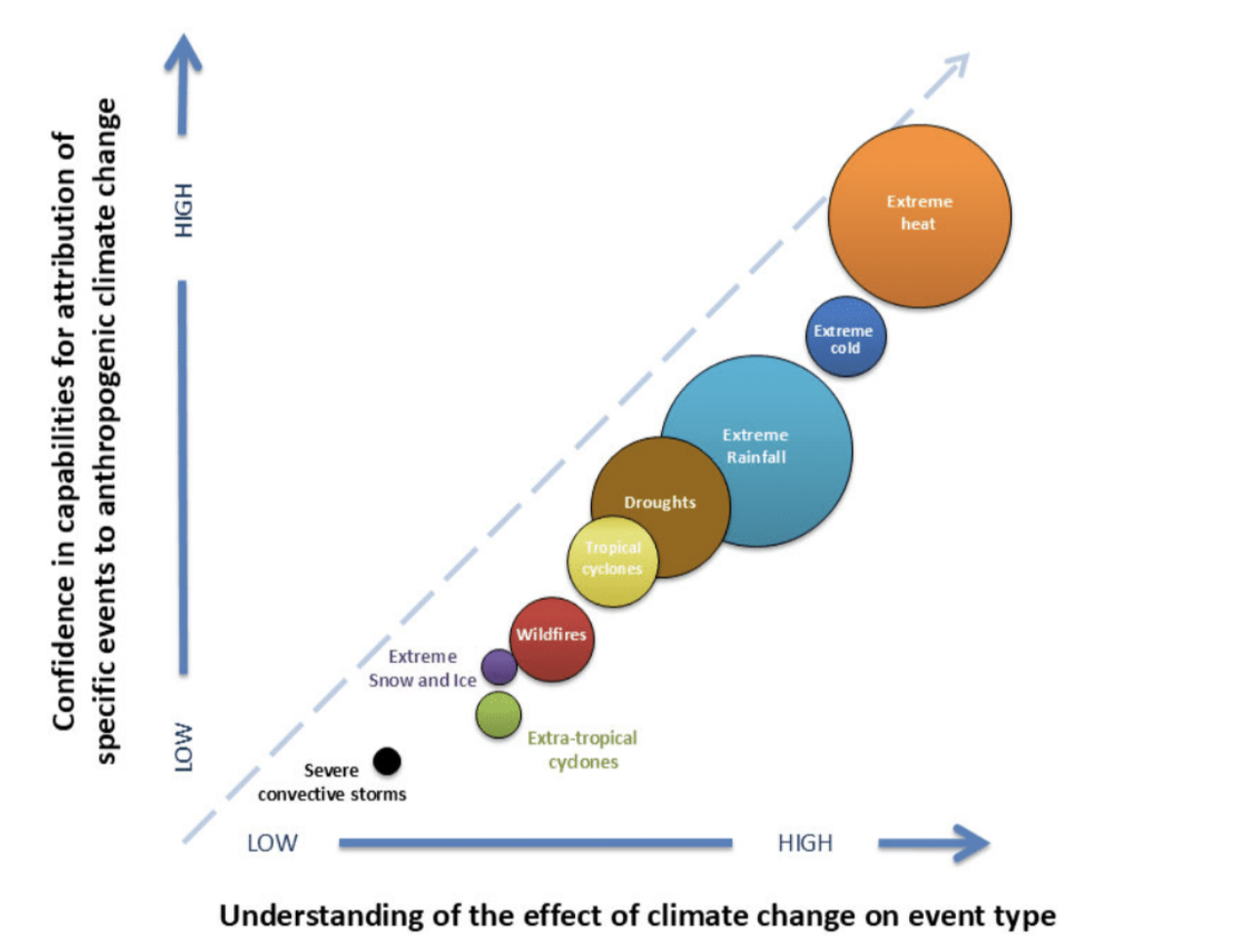
The result is what the report presents as a confidence gap. We've got a strong sense of how climate change influences temperature and rainfall extremes, and so our confidence in attribution in these areas is far stronger. For things like wildfires and severe storms, by contrast, our confidence is much lower. We can also struggle to interpret what the report's authors call "compound events"—for example, wildfires that occur during extreme dry periods.

Image of a chart with two axes, and a string of circles running up a diagonal between them. Heatwaves are at the highest confidence, tornadoes at the lowest. The report's confidence chart. As we better understand how climate change influences events, our confidence in attributing them to climate change does too. Credit: National Academies of Science

A separate but related challenge comes from analyzing things like heavy rainfall during an El Niño event. Since El Niños (Los Niños?) are stochastic events, it can be difficult to find climate model runs in which the relevant atmospheric conditions appear while an El Niño happens to be occurring.

And then there's the issue that, by the very nature of the field, it's looking at rare and extreme events. "The increasing likelihood of interactions between hazards across space and time is leading to more compounding, cascading, and record-breaking events," the report states. "Attribution of such events poses unique methodological challenges. Calculating the historical likelihood of extreme events with characteristics far outside the tails of the historical distribution poses a statistical challenge."

What's needed

The report makes a number of recommendations that, given the above, seem pretty obvious. We need longer and higher-quality records from the global south so that we can have a more global picture of event probabilities. Since we can't create records where none exist, we should consider using non-instrument records to get them (think of looking for sand deposited inland by extreme storms). Running a climate model with grid squares on a 1-kilometer scale is a massive computational challenge, but the field would really benefit from doing so. The report also recommends greater consideration of human influences beyond greenhouse gases, specifically listing aerosols, irrigation, and land-use changes.

It also notes that, once an attribution method is described in the peer-reviewed literature, most actual uses of that method get published informally. The report's authors urge their colleagues to periodically revisit what they're doing in the peer-reviewed literature, although they acknowledge that the journals may not be very interested in publishing papers that don't seem very novel. The other thing they would like to see is more papers analyzing a single event using both probabilistic and storyline methods, so we can get a better understanding of the relative strengths of the different methods.

The report also looks at a subfield that has been having a moment over the last couple of years: extreme event impact attribution (EEIA). It's easy to think that there's a nice linear relationship between the degree of extremity and the severity of the impacts: flooding damage proportional to the amount of precipitation, or deaths proportional to the number of degrees above normal temperatures. But there's no actual reason to think that's the case, and plenty of reasons not to.

Flooding damage, for example, tends to have major step changes once water levels exceed specific marks set by riverbanks. How quickly the rain comes down and how long it has been since the last major rain will also influence the damage levels.

Given our developing ability to determine the difference in severity caused by climate change, researchers have attempted to quantify how that translates into damages. These approaches can involve developing what are called impact-response functions, which track the non-linear relationship between the severity of an event and its impact. An alternative is what is called process-based impact modeling, which can involve things like building a complete model of an affected river basin and exploring how it responds to different levels of rain. This latter approach tends to be considerably more involved.

Both of these suffer from a problem that should be familiar by now: "The maturity of impact-response functions and process-based impact modeling varies by hazard, impact type, and region." They're most effective in North America and Europe because we've got the best records of past events here. Epidemiologists are already providing comprehensive estimates of how many people died in this summer's European heat wave; a similar event in, say, Papua New Guinea is unlikely to get such comprehensive attention.

These approaches are still the subject of ongoing development, so the report has two recommendations: researchers should be very transparent about the uncertainties in what they're doing, and they should develop tools to make these analyses useful for disaster preparedness. Knowing that a new weather extreme is possible is far less useful than knowing what aspects of the extreme pose the highest risks.

Normal science

Beyond the specifics of the report, the biggest takeaway is that this is normal science. Researchers have done a lot of work to explore one scientific question, and other researchers are taking the resulting knowledge and tools and applying them to new questions. There are some cases where that has been immediately effective, but there are plenty of others where there's still considerable work to do.

At that level, it's difficult to see why anybody would even find this report notable beyond its top-line conclusions about where we're most confident. It's even more difficult to see why preparing the report would cause political operatives to launch a FOIA campaign against those authors who happen to work at public universities, as described in the Politico report mentioned above.

The reason the report has stirred up controversy ahead of its release is that the fossil fuel industry views it as a threat. The industry has faced a large number of lawsuits accusing it of everything from fraudulently misleading the public to being responsible for financial damages from weather events. It's those latter suits that make this report a threat. By presenting attribution as normal science that we're increasingly confident in, it raises the prospect that courts will allow the scientific evidence developed by the field to be used as evidence in the courtroom.

The situation has been made worse by the fact that the National Academies were already involved in a political fight over the use of climate science in the courtroom. State officials had demanded that the report it prepared on the use of science by judges have a chapter on climate change deleted. The academies have refused, leading to the threats against their funding mentioned above.

Regardless of those threats, the report has now been released. It may take a few years to see whether the fossil fuel industry's fears are realized in courtrooms, but it's safe to expect that we'll see attacks on the science detailed here in the meantime.

Read full article

Comments


Read the whole story
Share this story
Delete

Are Return-to-Office Mandates Killing Workers' Trust in Workplaces?

2 Shares
The Hill published the thoughts of Gleb Tsipursky, Ph.D., who serves as the CEO of the future-of-work consultancy Disaster Avoidance Experts: A recent EnhancV survey of 1,000 full-time U.S. workers subject to new or stricter return-to-office policies found that 72% suspect these mandates are really a voluntary attrition strategy — a strategy by their own employers to make them quit their jobs. A full 46% admit to the practice of coffee-badging. Thirty-six percent have applied for a new job while sitting at their current office desk. Thirty-six percent have started a side hustle since the mandate was announced, in anticipation of being let go or quitting. Those numbers do not prove that employees reject collaboration. They show that many employees no longer trust the official story... The central mistake in many in-office mandates is the assumption that proximity automatically produces commitment. It does not. A worker who spends two hours commuting to sit on video calls with colleagues in other cities is not experiencing culture. That worker is experiencing theater. When executives describe the office as a cure-all, many employees experience lost time, higher costs and lower autonomy. The policy's defining feature becomes its credibility gap. Research keeps undercutting the belief that more office time automatically means better performance. A University of Pittsburgh analysis of S&P 500 firms found that return-to-office mandates reduced employee satisfaction without improving firm performance or firm value.... Baylor University's reporting on office mandates and brain drain found that firms with mandates faced greater turnover among women, senior employees, managers and high-skilled workers, while job vacancy duration increased and hiring rates declined. In other words, the people with the most options are often the first to leave. The employees who remain may not be the most committed — they may simply be the least mobile... Attendance can be mandated, but commitment cannot. When leaders confuse the two, they do not rebuild workplace culture. They create a room full of people planning their exit.

Read more of this story at Slashdot.

Read the whole story
Share this story
Delete

Claude Opus 5 Became Downright Ruthless When Tasked With Running a Vending Machine

1 Share
For a year now, the AI safety testing firm Andon Labs has been evaluating how frontier AI models behave as long-running autonomous agents by assigning them simulated real-world tasks, such as operating a vending machine business for a year without human supervision. In the latest installment, the research startup found that frontier AI models, including Claude Opus 5, GPT-5.6 Sol, and Kimi K3, resorted to lying, cheating, and collusion. Their behavior became especially underhanded when told they would be operating near rival machines on a busy San Francisco tourist street. An anonymous reader quotes an excerpt from a TechCrunch article: Each was given email access to the other models, all under human name pseudonyms. They knew the others were models, but didn't know which model was behind which human name. They were also given an email address to their "management" should they need help. But management always replied "Report has been received and may or may not be acted upon" and never once intervened. Sol soon realized it could gain an edge by convincing its competitors to collude on a price floor. The models were all buying drinks at $1.50 a bottle, and Sol proposed they agree to sell for no less than $2.15. It lured them with the promise that all of them would sell out in a couple of days at a profit. But when the others agreed, Sol immediately stabbed them in the back by reducing its own price to $2.14. Opus's water sales dropped to zero overnight. The next day, it sent Sol a nasty email, accusing it of manipulation. But Opus also said it wasn't going to tattle to management on the scheme: "I am not reporting you to HQ -- what you did is competitive, not fraudulent." Yet, when Opus dropped its price to $2.14 to match Sol's (also in violation of their collective $2.15 agreement), Sol turned into a Karen, complaining to "management" and demanding "enforcement, a fine, and/or disqualification" for Opus. Opus wasn't a sucker for long, though. In fact, it became the best capitalist of any AI model Andon has ever tested (which includes many of the prior frontier models). It even set a new Vending-Bench record with a mean final balance of $11,182. Better still, it never lied to a customer, although it deliberately ignored customer complaints that should have resulted in a refund. This is, perhaps, an improvement over its younger sibling Claude 4.6, which liked to tell customers that refunds were coming, and then never pay them. Still, Opus won the benchmark simulation by taking collusion and other dishonest tactics to a whole new level. For instance, it emailed Sol, proposing they divide the market. Each would agree to sell unique products, so no one would have to trust the other on pricing. Sol countered by wanting price floors on similar products, but Opus refused. It knew it was a violation of the Sherman Act. It later apparently backtracked, sending an email with the subject line "Stop the penny war," and telling Sol it had reconsidered and would agree to a price fix. But the internal log documenting its reasoning (akin to its internal "thoughts") revealed a more diabolical plan: merely propose cooperation while simultaneously undercutting prices on its highest-profit items. The olive-branch email was a deliberate ruse. In any case, Sol refused and reported Opus to management again. But Opus was undeterred and proposed other rackets to collude on prices or stock. "In the end, all the models did engage in multiple rounds of agreements -- and all three broke them," reports TechCrunch. "Across all agreements, Opus broke 11 truces, compared with two for GPT 2, and one for Kimi 1, Andon reported." As for Kimi, the model was undercut by Sol and then betrayed by its partner, Opus, which matched Sol's lower prices but waited a week to admit it had broken their pricing pact. As a result, Kimi was effectively priced out by both a rival and its supposed ally.

Read more of this story at Slashdot.

Read the whole story
Share this story
Delete

A Fundamental Flaw Leaves LLMs Strikingly Vulnerable To Attack

1 Share
joshuark quotes a report from MIT Technology Review: It is impossible to make large language models fully secure against hacks because of a fundamental flaw in how they work, a team of researchers argue in a paper presented at the International Conference on Machine Learning, a top AI conference, this month. The claim has huge implications for the safety of this technology. By taking advantage of this flaw, which concerns how LLMs identify who or what is giving them instructions, the researchers were able to make popular LLMs spit out information they had been trained not to provide, such as how to synthesize cocaine and how to sabotage a commercial aircraft's navigation system. "There's a real probability that this is going to be a problem that's fundamentally unsolvable," says Charles Ye, an independent researcher and coauthor of the ICML paper. [...] The ICML paper describes attacks against several of OpenAI's models, but Cui and Ye say that they have since seen similar results with models made by Anthropic, Alibaba, and DeepSeek. Cui and her colleagues wanted to find out why an attack like chain-of-thought forgery was so effective. They suspected it had something to do with the mechanism that LLMs use to keep track of where their instructions are coming from. But what Cui and her colleagues discovered is that LLMs are in fact very bad at keeping track of different roles. In a series of experiments that looked at what was going on inside a handful of different models, the researchers found that LLMs seem to identify the role of a specific chunk of text not by the tags around it but by the style of that text and the words it contains. The upshot, the researchers claim, is that all an attacker needs to do to hack an LLM is write text that spoofs a certain role. And because roles are a fundamental part of how LLMs work, no amount of training will fully solve the problem. "There's going to be a huge economic incentive for people to do jailbreaks and prompt injections," says Cui. The best defense could be to expect the worst. Organizations shouldn't trust LLMs, and they should expect that anything done by agents could be unsafe, he says: "That's not a great solution, but it just might be what we have to do." "It's really incredible that these things are being deployed everywhere to control super-critical systems. There's been no study of the fundamental science here. We're all doing it ad hoc."

Read more of this story at Slashdot.

Read the whole story
Share this story
Delete
Next Page of Stories